
The Psychology of Habit Change: Big Hairy Audacious Goals vs Micro Habits
August 31, 2026
How to Find the Right Therapist: Why the Right Fit Matters More Than You Think
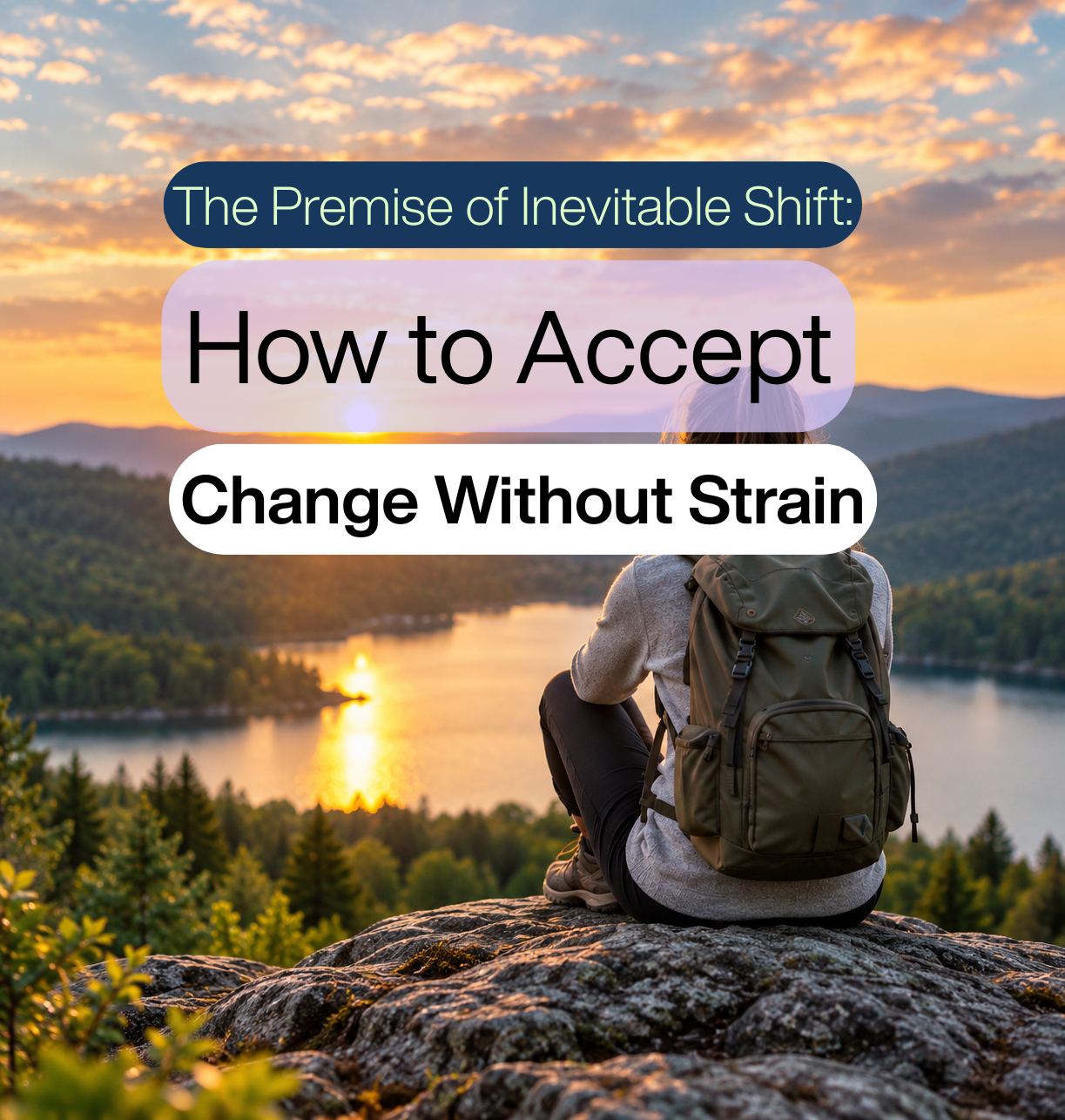
September 7, 2026The Premise of Inevitable Shift:
How to Accept Change Without Strain
Change Is Part of Life
Change is one thing in life that nobody can completely avoid. People change, relationships change, businesses change, careers change, technology changes, and even our own priorities change as we grow.
Yet, although change is inevitable, many of us still struggle when it arrives. The real struggle often comes from how we think about the change, what we assume will happen next, and how strongly we hold on to what used to be.
Learning how to accept change without strain begins with understanding that change is a normal part of life rather than a personal attack or a sign that something has gone wrong. Once we stop treating every transition as a threat, we can respond with greater clarity, patience, and confidence.
Why Change Feels So Difficult
One reason change creates stress is that it moves us away from what feels familiar. Familiar routines give us a sense of control. We know what to expect, how things work, and what our role is. When something changes, that certainty can disappear.
For example, a company may introduce a new system or an employee may suddenly have different responsibilities. The first reaction may be frustration. But the change itself may not be the biggest issue; the uncertainty surrounding it may be.
This is why overcoming fear of change requires looking beyond our first emotional reaction. Instead of deciding that change will be negative, pause and ask what is actually happening.

Separate Facts From Assumptions
A powerful way of dealing with uncertainty is to separate facts from assumptions. When change happens, our minds often fill in the gaps with predictions. We may imagine everything going wrong before we have enough information to know what will actually happen.
Suppose a business changes its structure. The fact may simply be that responsibilities are being reorganized. The assumption might be that the company is going to fail, that someone's job is no longer safe, or that the new system will be terrible.
Those thoughts may feel real, but they are still assumptions.
Focus on What You Can Control
Change becomes easier to handle when we stop spending all our energy trying to control things that are outside our influence.
We cannot control every decision made by a company. We cannot control other people's reactions. We cannot stop technology from developing or prevent life from moving into a new season. However, we can control how we respond.
What You Can Control
- Your preparation
- Your attitude
- Your communication
- Your effort
- Your daily choices
What You Cannot Control
- Other people's reactions
- Every decision around you
- Technology developing
- Every future outcome
- Life moving into a new season
Instead of: “Why is this happening to me?”
Ask: “What can I do with the situation I have now?”

Change in the Workplace and Business
The need for adaptability is especially clear in the workplace. Businesses have to respond to new technology, customer expectations, competition, economic conditions, and changing markets.
As a result, employees may experience new systems, new leadership, new responsibilities, or changes in company direction.
Trying to keep everything exactly as it was is rarely realistic. A business that refuses to adapt can fall behind.
But accepting change does not mean accepting every decision without thought. It means being willing to understand the reason for the change, learn what is required, and adjust where necessary.
For employees, this can mean learning a new skill, asking questions, supporting colleagues, or finding a better way to organize daily tasks. For leaders, it can mean communicating clearly and recognizing that people need time to adapt.
The goal is not to eliminate discomfort, but to prevent it from becoming unnecessary resistance.
Do Not Let One Change Define Everything
Another useful principle is to avoid turning one change into a judgment about your entire future.
If something does not go according to plan, it does not automatically mean everything is falling apart. A difficult transition can still lead to a better opportunity, a new skill, a stronger relationship, or a clearer understanding of what you want.
When we treat one uncertain moment as proof of a terrible future, we create strain before the future has even arrived.
Instead, take change one step at a time. You do not need to solve every possible problem today.

Build Stability While Things Change
Accepting change does not mean living without stability. In fact, maintaining healthy routines can make transitions much easier.
Simple habits can provide a sense of continuity when other parts of life are shifting.
- ✓ Getting enough rest
- ✓ Staying organized
- ✓ Exercising
- ✓ Spending time with supportive people
- ✓ Keeping important daily routines
During life transitions, small routines remind us that not everything is changing at once.
It is also helpful to keep learning. Developing skills and staying open to information builds confidence in unfamiliar situations.
See Change as an Opportunity to Learn
Change often reveals abilities that we did not know we had. A new responsibility may teach leadership. A difficult transition may improve communication. A new environment may introduce relationships and opportunities that would never have appeared otherwise.
This does not mean every change is enjoyable. Some changes are genuinely painful, and accepting change is not the same as pretending everything is easy.
It means allowing reality to be what it is while deciding how you want to move forward.

A Practical Approach to Accepting Change
The next time something changes, try this simple process.
Pause
Give yourself time to understand what is happening before reacting.
Identify the Facts
Write down what you actually know instead of focusing on predictions.
Identify What You Can Control
Choose the actions that are available to you right now.
Accept What You Cannot Control
Resistance can consume energy even when it cannot reverse the situation.
Take the Next Step
You do not need to know the entire journey—only the next good decision.
Conclusion
Inevitable change is not something we can remove from life. The more realistic goal is to develop the ability to move through change without allowing fear, assumptions, and resistance to create unnecessary strain.
Whether change involves your personal life, relationships, career, or business, the same principle applies: focus on reality, not imagined outcomes; focus on what you can control, not what you cannot; and remain willing to learn.
Learning how to accept change without strain is ultimately a mindset shift. Change may be uncomfortable, but it does not have to control your response.
When you become more adaptable, you can face uncertainty calmly, make better decisions, and keep moving forward even when the path looks different from what you expected.
Ready to Take the Next Step?
Counseling can help you navigate change with greater clarity and confidence.