Decoding the Silent Language: Understanding the 55% Rule of Human Communication
October 20, 2026
Communication • Clarity • Understanding
Why Everything You’ve Heard About the 7-38-55 Rule Is Wrong
The Myth We’ve All Bought Into
Picture this: You’re sitting in a packed auditorium or a corporate seminar. The speaker steps up to the edge of the stage, lowers their voice for dramatic effect, and hits you with a stat that feels mind-blowing:
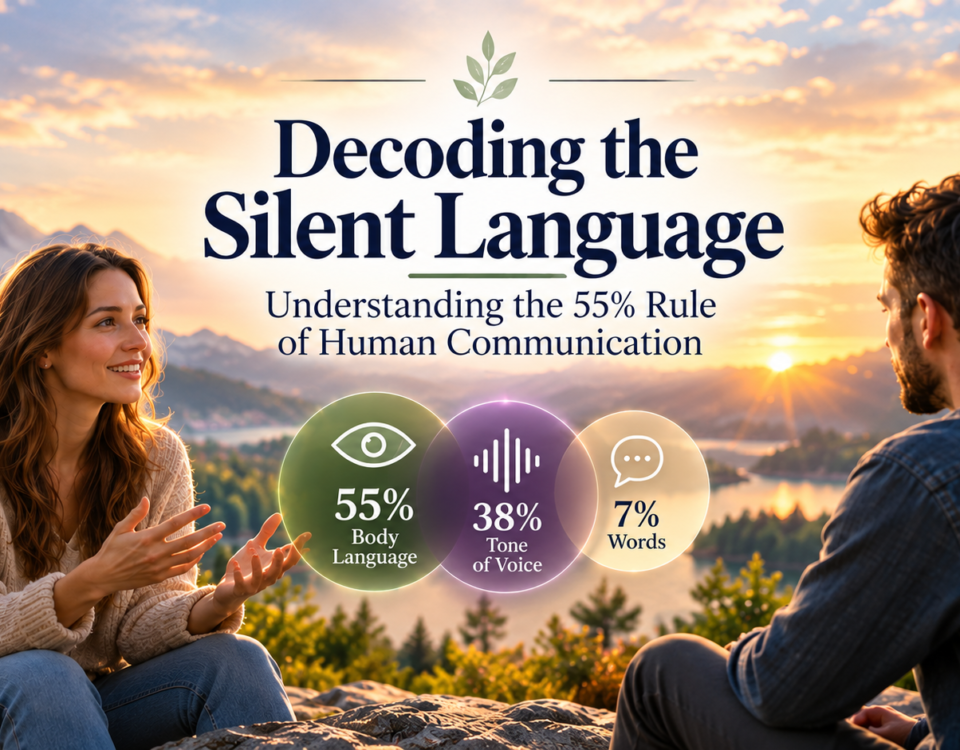
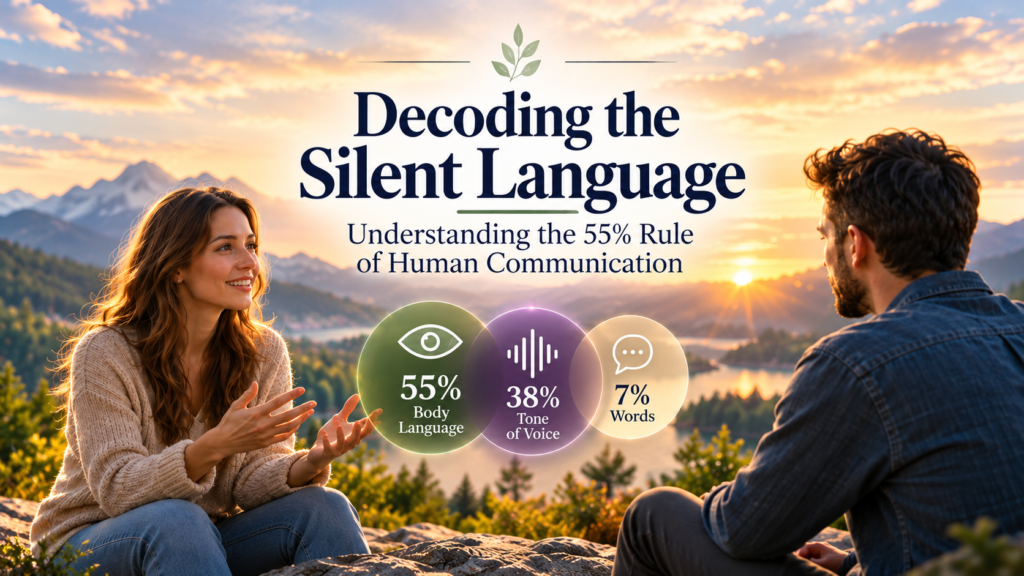
“Did you know that 55% of communication is body language, 38% is your tone, and only 7% is the actual words you use?”
It sounds great, right? It’s catchy, easy to toss around in meetings, and practically begs to be shared on LinkedIn.
There’s just one tiny issue: It’s complete nonsense as a universal rule.
When we try to slice human interaction into neat little math equations like 55-38-7, we completely miss how messy, beautiful, and deeply context-dependent human communication actually is. So, where did this famous rule come from, why is it so deeply misunderstood, and what does it actually take to connect with people? Let’s break it down.
Watch the Video
A closer look at the 7-38-55 myth and what actually helps us connect.
Where the “Rule” Actually Came From
To figure out how a simple misunderstanding turned into global gospel, we have to travel back to the late 1960s. A UCLA psychology researcher named Dr. Albert Mehrabian wanted to figure out how people read into feelings and attitudes, specifically when a speaker’s words didn’t match their vibe.
He ran a couple of very specific experiments:
- In one, people listened to a recorded speaker say a single word—like “maybe”—using different tones to show liking, neutrality, or dislike.
- In another, people looked at facial expressions paired with words and had to guess the emotional intent.
By averaging out these hyper-specific scenarios, Mehrabian came up with a formula for expressing feelings of liking or disliking: 7% words, 38% tone, 55% facial or visual cues.
The Game of Telephone
Somewhere along the line, speakers and coaches took a narrow laboratory study about how we judge emotional warmth or dislike and turned it into a blanket rule for every single thing we say.
Think about how absurd that is. If words only accounted for 7% of communication, you could completely ignore the vocabulary in a medical prescription, a legal contract, or a technical manual—just as long as you crossed your arms right or used a friendly voice tone! Obviously, that’s ridiculous. In real life, the words we choose carry immense, irreplaceable weight.
The Real Power Trio: Words, Tone, and Body Language
While Mehrabian’s percentages don’t apply to everyday life, he did identify three important elements of face-to-face interaction: what we say, how we say it, and how we look while saying it. Let’s look at how they actually play together.
Words: The Blueprint of Meaning

Words are how we share complex thoughts, build arguments, and pass down knowledge. Without them, nuance disappears entirely.
When you write an email, draft a strategy document, or explain a difficult concept, your vocabulary is doing the heavy lifting. To claim words only matter 7% of the time is to dismiss poetry, science, history, and law. Words matter because they create the framework of our thoughts.
Tone: The Emotional Volume Knob
Your tone—pitch, speed, volume, and inflection—acts as an emotional multiplier.
- I didn’t say it (someone else might have).
- I didn’t say you stole it (perhaps someone else).
- I didn’t say you stole the money (perhaps something else).
Your tone gives your words a heartbeat. It tells people whether you’re joking, furious, sarcastic, or sincere.
Body Language: The Visual Anchor

Our gestures, posture, and facial expressions set the visual stage. We are often attentive to physical cues when trying to understand someone’s feelings and engagement.
If someone says they are excited about a new project while slouched, avoiding eye contact, and showing little expression, you may notice a mismatch. Such cues can invite a thoughtful question, but they are not certain proof of what someone feels. When your physical presence matches your message, it can help build trust.
Why Context Trumps All
We all love a quick fix—a simple formula that promises to turn us into master communicators overnight. But human connection doesn’t work that way.
The importance of words versus nonverbal cues depends entirely on where you are and what you’re doing:
Writing an email or a text: Facial expressions and spoken tone are absent. Your words carry the message, which is why punctuation and emojis can matter so much.
A high-stakes negotiation: In a courtroom or a business deal, exact wording can mean the difference between winning and losing. Words take the crown here.
Meeting someone for the first time: Before you even open your mouth, a warm smile and an open posture may help others feel comfortable enough to connect.
Instead of asking “Which percentage matters most?”, a better question is: “How can I get these three elements working together instead of fighting each other?”
How to Actually Level Up Your Communication
If we throw out the 7-38-55 rule, how can we become better speakers, leaders, and partners? Here is a practical way to tune up all three pillars:
Choose Your Words Carefully: Cut out filler words (like “um” and “you know”) where possible. Know who you’re talking to and tailor your language so people understand you without feeling talked down to.
Pay Attention to Your Voice: Slow down when you’re nervous. Deliberate pacing can help create clarity and confidence. Make sure your vocal energy matches what you’re talking about.
Open Up Physically: Relax your shoulders, use natural eye contact when appropriate, and let your hands move naturally to emphasize your points rather than trying to hold a rigid pose.
Communication is not about memorizing a percentage. It is about being present, paying attention, and adapting to the person in front of you.

Conclusion: It’s Not a Formula, It’s a Skill
The obsession with the 7-38-55 rule just proves how much we crave simple answers to complicated human habits. While Dr. Mehrabian’s old study taught us about emotional mixed signals, it was never meant to be a universal rule.
Words matter. Tone matters. Body language matters. None of them work in a vacuum, and none can be brushed aside as a minor detail.
The next time someone tries to tell you that words barely matter, remind them: delivery might make a performance memorable, but words are what shape meaning. When you align your vocabulary, your voice, and your presence, you stop worrying about misleading stats and start becoming a genuinely authentic communicator.
“Human communication is not a math equation. It’s a dynamic, evolving skill that blends words, tone, and body language in every unique moment.”
Ready to Take the Next Step?
A therapist can help you strengthen your communication skills, build healthier relationships, and navigate life’s challenges with greater confidence.