Decoding Connection: Why Communication is the Ultimate Foundation of Every Relationship
October 8, 2026
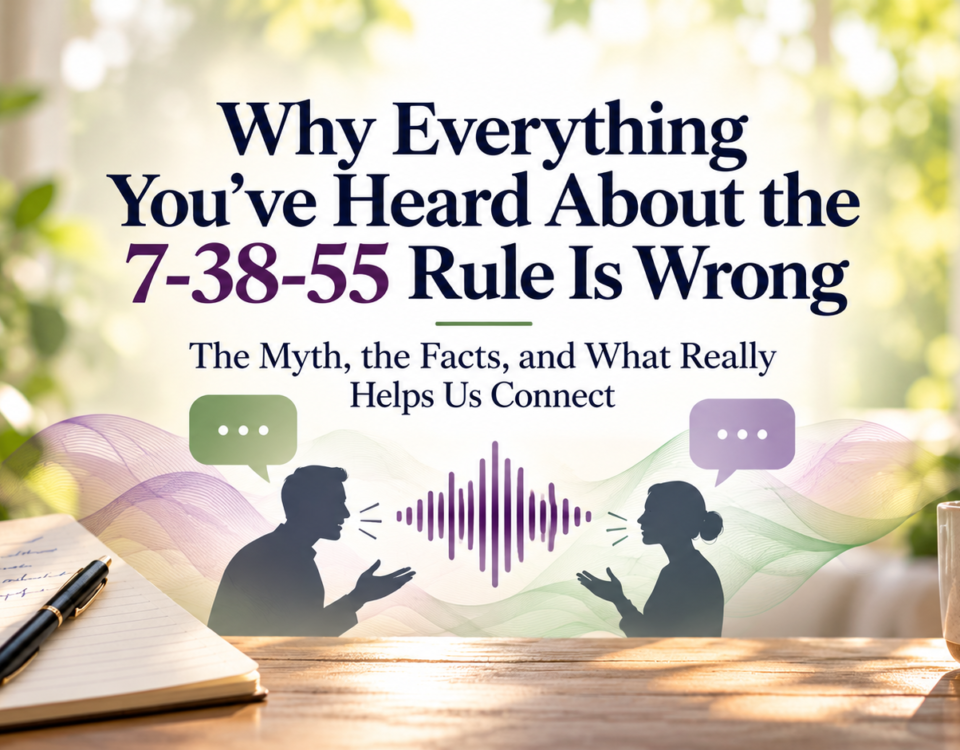
Why Everything You’ve Heard About the 7-38-55 Rule Is Wrong
October 20, 2026
Communication • Connection • Understanding
Decoding the
Silent Language
Introduction: The Words We Say vs. the Way We Say Them
Have you ever walked away from a conversation feeling like something was “off,” even though the other person said all the right words? Or perhaps you’ve heard a simple “I’m fine” that seemed to carry an entirely different meaning.
We spend years learning vocabulary, mastering grammar, and refining how we speak. Yet our words are just one part of the way we connect with others. Our facial expressions, gestures, posture, and tone also help convey our feelings.
When the words, tone, and body language in a conversation align, a message often feels clearer. When those signals conflict, we may become unsure what the other person really means.
In this guide, we’ll explore the psychology of nonverbal communication and practical ways to strengthen personal and professional relationships.
Watch the Video
The Three Pillars of Communication
Three channels work together every time we communicate.
Verbal
Communication
The words, phrases, and information we choose to express.
Tone
of Voice
Pitch, volume, pace, and warmth that give words emotional meaning.
Body
Language
Posture, gestures, facial expressions, and physical distance.
Words communicate facts, ideas, requests, and stories.
Tone can make the same sentence sound warm, frustrated, nervous, or sarcastic.
Body language includes posture, hand movements, expressions, eye contact, and personal space.
The Astonishing Statistic: The 55% Rule
Psychologist Albert Mehrabian’s research is often summarized using a memorable formula: 55% visual cues, 38% vocal cues, and 7% words. These findings concerned how people interpret feelings and attitudes when messages are inconsistent.
What they help us remember is that in emotionally sensitive situations, what others see and hear can influence how they understand our words.
Important context: The 7–38–55 figures come from a narrow set of studies about communicating feelings and attitudes, particularly when signals conflict. They do not mean that words account for only 7% of all communication.
Why Nonverbal Cues Override Spoken Words
Why might someone’s slumped shoulders or hesitant tone seem more convincing than their assurance that “everything is fine”? People use multiple cues to interpret emotion, and incongruence often invites a closer look.
Evolutionary Awareness
Humans are attentive to physical signals of safety, tension, connection, and social intention. This can shape our first impressions during an interaction.
Signals Can Be Hard to Coordinate
A person’s voice and expressions may not always match their words, especially under stress. That mismatch may reveal discomfort, but it is not proof that someone is lying.
Emotional Resonance
Emotions often affect our posture, facial muscles, and vocal delivery. Observing those cues alongside spoken words can help us respond with empathy rather than assumptions.
Real-World Applications: How to Master Your Nonverbal Presence
Understanding nonverbal communication can help us build stronger relationships, avoid misunderstandings, and become more intentional communicators at home, at work, and in everyday life.

Be Aware of Your Body Language
- Notice your posture and gestures.
- Relax your shoulders when possible.
- Consider what your facial expression conveys.
- Use comfortable, respectful eye contact.

Use Tone Intentionally
- Listen to your pitch, volume, and pace.
- Let your voice support your meaning.
- Pause rather than rushing.
- Be mindful of unintended sarcasm.

Match Your Signals
- Align words, tone, and expression.
- Notice when your signals conflict.
- Match encouragement with warmth.
- Practice authentic communication.

Read Others More Accurately
- Observe expressions and shifts in posture.
- Listen carefully to tone.
- Consider context and individual differences.
- Ask questions instead of guessing.

Practice in Real Situations
- Apply these skills in daily conversations.
- Invite constructive feedback.
- Be patient with yourself.
- Improve through small, steady changes.
Try this today: During your next conversation, ask yourself: “How am I sitting or standing? What is my expression saying? Do my tone and words fit together?” Then notice the other person’s cues, while remembering that body language is not a mind-reading tool.
Conclusion: Becoming Fluent in the Silent Language
Communication is far more than an exchange of words. It is a combination of meaning, presence, voice, and expression. Words help us share ideas; tone and body language help express how those ideas feel.
By becoming more aware of our own nonverbal signals, we can reduce misunderstandings, show empathy, and communicate with greater clarity and authenticity.
So the next time you enter a conversation, notice your posture, soften your expression when appropriate, listen carefully, and allow your words, voice, and body language to support the same message.
“When our words, tone, and body language align, communication flows and trust grows.”

Ready to Take the Next Step?
A therapist can help you strengthen your communication skills, build healthier relationships, and navigate life’s challenges with greater confidence.